







What Is the Difference Between Metal Takeoff and Metal Estimating in Texas?

21
0
·
2026/04/15
·
6 mins read
☕
WriterShelf™ is a unique multiple pen name blogging and forum platform. Protect relationships and your privacy. Take your writing in new directions. ** Join WriterShelf**
WriterShelf™ is an open writing platform. The views, information and opinions in this article are those of the author.
Article info
Tags:
Total: 1285 words
Like
or Dislike
More to explore


Construction projects are rapid in Texas. Contractors deal with tight deadlines, the increase in material costs, and intensive competition in bids. Due to that, correct estimating is not a matter of choice. It is a major component of securing employment and safeguarding profit margins.
Nevertheless, many contractors mix up two similar terms: metal takeoff and metal estimating. Although both are related, they are not the same. They each have a different use in the project planning and bidding. Knowing the difference will help you to prevent expensive errors and enhance budget control.
This is good in the rapidly developing markets such as Houston, Dallas, Austin, and San Antonio. Commercial and industrial buildings are growing rapidly in these cities. Thus, professionals need effective cost forecasting.
We shall elaborate in this blog on the distinction between Steel takeoff and Steel estimating with reference to projects in Texas.
Construction projects are rapid in Texas. Contractors deal with tight deadlines, the increase in material costs, and intensive competition in bids. Due to that, correct estimating is not a matter of choice. It is a major component of securing employment and safeguarding profit margins.
Nevertheless, many contractors mix up two similar terms: metal takeoff and metal estimating. Although both are related, they are not the same. They each have a different use in the project planning and bidding. Knowing the difference will help you to prevent expensive errors and enhance budget control.
This is good in the rapidly developing markets such as Houston, Dallas, Austin, and San Antonio. Commercial and industrial buildings are growing rapidly in these cities. Thus, professionals need effective cost forecasting.
We shall elaborate in this blog on the distinction between Steel takeoff and Steel estimating with reference to projects in Texas.
How Metal Material Takeoff Works in Construction Projects?
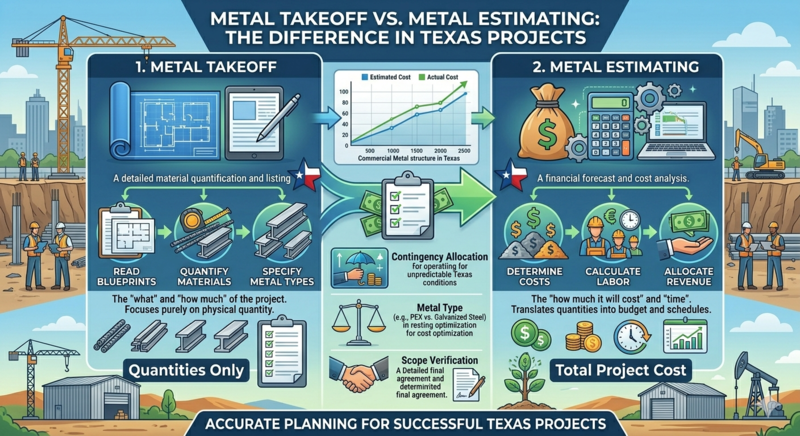
A Metal quantity takeoff is mainly about quantities. It focuses on measuring and listing the amount of metal required from the project drawings. It does not calculate the full project cost. Instead, it tells you how much material you need.
A Metal quantity takeoff includes the measurement of steel, aluminum, and other metal components. It usually covers:
Structural steel beams and columns
Metal studs and framing
Sheet metal panels
Steel plates and angles
Rebar quantities
Fasteners and connectors
Contractors use takeoffs to order materials correctly. As a result, they avoid shortages and reduce waste. When takeoff is accurate, suppliers can deliver the correct amount. Therefore, the project stays on schedule. In addition, contractors can avoid emergency material orders, which are often expensive. A metal takeoff is the first step before pricing. However, it is not the complete estimate.
Metal Cost Estimating Includes Beyond Takeoff
While takeoff focuses on quantity, Metal cost estimating focuses on total cost. It includes material pricing, labor, equipment, and overhead. We use a complete cost breakdown for bidding.
A professional metal estimate includes:
Metal material cost
Fabrication charges
Delivery and transportation cost
Installation labor cost
Equipment rental and crane cost
Welding and cutting costs
Safety and compliance expenses
Profit margin and overhead
Metal Cost Estimating Assists Contractors in Winning Bids
Bids are competitive in Texas. Contractors are not allowed to underprice. Wrong pricing can lead to loss of profit or even loss of the project by the contractor. That is why Steel estimating plays a key role in bid success. It helps contractors price work correctly while staying competitive.
Why Metal Estimating in Texas Requires Special Market Knowledge?
Texas is a unique construction market. Pricing changes quickly due to demand, labor availability, and transportation costs. Therefore, estimators must understand local conditions.
Texas has a high demand for Steel and Industrial Projects
Many large projects in Texas include oil and gas facilities, warehouses, and manufacturing plants. These projects require heavy steel work. Because of that, steel demand affects pricing. This is why metal cost estimating in Texas must include updated market rates. Otherwise, the estimate becomes outdated and unreliable.
Local Labor Rates Impact Total Estimation
Labor rates differ across Texas cities. For example, labor costs in Austin may be different from costs in smaller towns. Therefore, accurate estimating requires regional labor research. That is why professional Metal cost estimating in Texas gives better accuracy than generic estimating methods.
Metal Takeoff vs Metal Estimating: Know the Difference
The two processes complement each other, but they have different functions. Contractors can understand this difference to deal better with bids and project budgets.
Metal Quantity Takeoff Focuses on Quantities
A Steel takeoff answers questions like:
How many beams are needed?
What quality of pounds of steel are required?
How much rebar is required?
How many sheets of metal are needed?
It gives a material list. However, it does not tell you the total project cost.
Steel Estimating Focuses on Total Cost
On the other hand, Steel cost estimation answers questions like:
What number of beams are needed?
How many pounds of steel are required?
How much rebar is required?
What number of sheets of metal are needed?
So, takeoff is the base, but estimating is the final calculation. In short, metal takeoff is about measurement, while steel estimating is about money.
Industrial Estimating Relates to Metal Work
Texas has a strong industrial construction market. Many projects involve refineries, power plants, and large warehouse developments. These projects require advanced estimating. That is where industrial estimating becomes important.
Industrial projects involve heavy steel structures and specialized installations. Therefore, estimating must include:
Structural steel fabrication complexity
Welding requirements
Safety standards and inspections
Crane and lifting equipment costs
High-performance material specifications
Because of these needs, industrial estimating must be more detailed than residential estimating. Also, it requires knowledge of industrial codes and project demands. Metal estimating becomes the core part of industrial estimating because steel is a major cost driver.
Rebar Estimating Services in Texas Projects
Rebar is a major part of concrete reinforcement. It is commonly used in foundations, slabs, columns, and beams. Since Texas has many large commercial developments, rebar estimation is always in demand. That is why Rebar estimating Services are important.
Rebar Estimation Includes Both Material and Labor
Rebar estimation is not only about quantity. It also includes cutting, bending, tying, and placement labor. Therefore, professional steel estimating reports are included in Rebar estimating Services. They help contractors prepare accurate bids for foundation and structural work.
When Contractors Need Metal Takeoff and When They Need Metal Cost Estimating?
Both services are useful, but the need depends on project goals.
When You Only Need Steel Takeoff
You may only need a metal takeoff if:
Already know material prices.
Only need quantity lists for ordering.
You are managing internal project planning.
You are comparing supplier quotes.
In these cases, takeoff supports purchasing decisions.
You Need Full Metal Cost Estimating
You need metal estimating if:
Preparing a bid proposal.
Need the labor and equipment costs included.
You want full cost forecasting.
You want profit margin and overhead calculations.
Full estimating is usually required for contractors bidding on commercial work.
Conclusion
Many contractors use metal takeoff and estimating interchangeably. However, they are different processes. A Metal quantity takeoff focuses on measuring quantities from drawings. It helps contractors order materials accurately. On the other hand, metal estimating includes total project pricing. It covers labor, equipment, fabrication, delivery, and profit.
In fast-moving markets, steel estimating in Texas requires local pricing knowledge and accurate labor forecasting. It becomes even more important for large warehouse and oil-and-gas projects. Additionally, industrial estimating depends heavily on steel pricing and installation complexity. For reinforced concrete structures, Rebar estimating Services also play a major role in cost planning.
You need to know these differences to minimize errors, prevent shortages, and increase the accuracy of bids. Contractors can manage costs and deliver projects successfully in Texas with the appropriate planning.